How to Find Guest Posting Opportunities: 15 Proven Methods (2026)
Write a compelling excerpt...
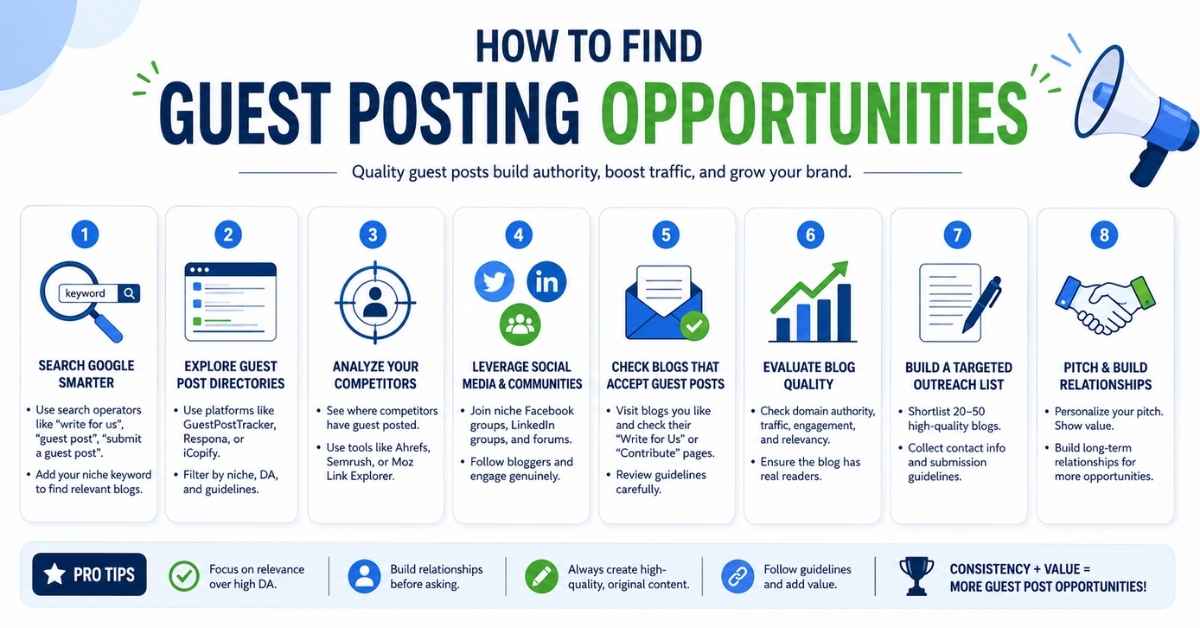
How to Find Guest Posting Opportunities is easier when you follow a proven strategy instead of relying on random Google searches. The best way to find guest posting opportunities is to identify niche-relevant websites, evaluate their SEO quality, and reach out with a personalized pitch that provides value to their audience. Whether you're a blogger, business owner, or SEO professional, the right guest posting opportunities can help you earn high-quality backlinks, improve organic rankings, increase website authority, and drive targeted referral traffic. In this guide, you'll learn practical methods used by experienced link builders to consistently discover websites that accept guest posts and build long-term publishing relationships.
Guest posting remains one of the most effective white-hat SEO strategies because it combines content marketing, relationship building, and editorial backlinks. However, success depends on finding websites that are relevant, trustworthy, and genuinely interested in publishing valuable content—not simply any site with a "Write for Us" page.
Why Finding the Right Guest Posting Opportunities Matters
Not every guest posting opportunity will improve your SEO. Publishing on low-quality websites can waste your time and, in some cases, even harm your site's reputation. On the other hand, securing a guest post on a respected website in your niche can deliver long-term benefits.
Here are some of the biggest advantages of targeting the right websites:
- Earn high-quality backlinks that support your SEO strategy.
- Increase organic traffic through referral visitors.
- Build your brand authority within your industry.
- Reach a new audience interested in your expertise.
- Develop relationships with editors, bloggers, and website owners.
- Improve your website's trustworthiness and online presence.
The goal is not to publish on hundreds of websites. Instead, focus on websites that have real traffic, active readers, and strong editorial standards.
What Makes a Guest Posting Opportunity Worth Pursuing?
Before sending a pitch, evaluate whether the website is worth your effort.
Signs of a High-Quality Website
A valuable guest posting site usually has these characteristics:
- Topically relevant to your niche.
- Consistent organic traffic from search engines.
- Regularly updated, high-quality content.
- Clear editorial guidelines.
- Real authors with detailed profiles.
- Healthy backlink profile.
- Engaged audience through comments or social shares.
- Indexed pages that appear in Google search results.
Publishing on websites with these qualities improves both your credibility and your chances of gaining meaningful SEO value.
Red Flags You Should Never Ignore
Many websites advertise guest posting but offer little real value. Avoid websites that show these warning signs:
- Thin or poorly written articles.
- Excessive outbound links in every post.
- Unrelated topics published on the same website.
- Extremely high Domain Rating but almost no organic traffic.
- Obvious Private Blog Network (PBN) characteristics.
- Spammy advertisements covering the page.
- Poor user experience and outdated content.
If a website appears to exist only for selling backlinks, it's usually better to move on.
Quick Website Evaluation Checklist
Before contacting any website, review the following:
| Evaluation Factor | Why It Matters |
| Organic Traffic | Indicates real audience engagement |
| Topical Relevance | Helps build contextual backlinks |
| Domain Rating (DR) | Measures backlink strength |
| Domain Authority (DA) | Useful as a secondary metric |
| Spam Score | Lower is generally better |
| Indexed Pages | Confirms Google trusts the site |
| Content Quality | Reflects editorial standards |
| Author Profiles | Demonstrates credibility |
Remember, traffic and relevance are often more valuable than authority metrics alone.
15 Proven Ways to Find Guest Posting Opportunities
1. Use Google Search Operators Like an SEO Professional
Google remains one of the most powerful tools for discovering guest posting opportunities.
Search operators help uncover websites that actively accept guest contributions.
Try searches like:
- SEO "Write for Us"
- Marketing "Guest Post"
- Technology "Become a Contributor"
- Finance "Submit an Article"
- Travel "Guest Author"
- Business "Contribute"
You can also combine keywords to uncover hidden opportunities, such as:
- Digital Marketing + "Write for Us"
- SaaS + "Guest Blog"
- Health + "Accepting Guest Posts"
These targeted searches reveal niche websites that may not appear through general searches.
2. Reverse Engineer Your Competitors' Backlinks
One of the smartest ways to find guest posting opportunities is by studying competitors who already rank well.
Use SEO tools to examine where competitors have earned backlinks.
Look for:
- Guest author biographies.
- Contributor pages.
- Editorial mentions.
- Resource pages.
- Industry blogs.
If a website accepted one guest article in your niche, it may welcome another high-quality submission.
This strategy saves time because you're targeting websites with a proven history of publishing guest content.
3. Explore Competitor Author Profiles
Many writers contribute to multiple websites.
When you find an excellent guest post, click on the author's profile.
You'll often discover links to:
- Personal websites.
- Other published articles.
- Contributor pages.
- Social profiles.
Following successful contributors can quickly reveal dozens of additional guest posting opportunities.
4. Use Professional SEO Tools
Professional SEO platforms simplify prospect research.
Useful tools include:
- Ahrefs
- Semrush
- Moz
- Majestic
These tools help you:
- Analyze competitor backlinks.
- Discover referring domains.
- Identify websites with strong organic traffic.
- Evaluate link quality.
- Prioritize outreach targets.
Rather than contacting hundreds of websites, focus on those with genuine SEO value.
5. Search Beyond Basic "Write for Us" Pages
Many websites don't advertise guest posting openly.
Instead, search for phrases such as:
- Become a Contributor
- Editorial Guidelines
- Contribute
- Guest Author
- Submit Content
- Share Your Expertise
- Content Collaboration
These searches often uncover valuable websites overlooked by most marketers.
6. Use LinkedIn to Connect With Editors
LinkedIn is an excellent place to build relationships before pitching.
Search for:
- Content Editor
- Managing Editor
- Editorial Manager
- Content Marketing Manager
- Blog Editor
Engaging with editors through comments and thoughtful interactions makes your outreach more recognizable and increases response rates.
7. Find Opportunities Through Online Communities
Many guest posting opportunities are shared inside niche communities rather than on search engines.
Explore:
- Reddit communities
- Facebook Groups
- X (formerly Twitter)
- Slack communities
- Discord groups
- Industry forums
Blog owners often announce contributor opportunities directly to their communities before publishing them elsewhere.
8. Browse Industry Blogs and Resource Pages
Many industries maintain curated directories of trusted blogs.
Search for:
- Best blogs in your niche
- Industry publications
- Resource pages
- Top marketing blogs
- Business magazines
- Startup publications
These lists often introduce you to websites actively seeking expert contributors.
9. Monitor Newly Published Guest Posts
Watch where respected professionals publish their latest articles.
If a website recently accepted one guest contributor, there's a strong chance it will consider another relevant pitch.
Monitoring new publications helps you target websites that are currently active rather than outdated guest posting lists.
10. Use AI to Speed Up Prospect Research
Artificial intelligence can help organize and accelerate your research.
Use AI to:
- Generate search operator ideas.
- Categorize websites by niche.
- Create outreach tracking sheets.
- Suggest content ideas.
- Draft personalized email outlines.
However, always verify every website manually to ensure it meets your quality standards.
11. Explore Newsletters and Podcast Websites
Many podcast hosts and newsletter publishers also run blogs that welcome expert contributions.
These websites often have:
- Loyal audiences.
- High engagement.
- Strong topical authority.
- Opportunities for long-term collaboration.
Searching beyond traditional blogs can uncover valuable publishing opportunities that competitors often overlook.
12. Build Relationships Before Pitching
Cold outreach works, but warm relationships work even better.
Before sending your pitch:
- Read recent articles.
- Leave meaningful comments.
- Share their content on social media.
- Mention their work naturally.
Editors are more likely to respond to contributors who have already demonstrated genuine interest in their publication.
13. Ask Existing Publishing Partners for Referrals
One successful guest post can lead to many more.
After your article is published, ask the editor if they can recommend:
- Sister websites.
- Partner publications.
- Industry blogs.
- Other editors seeking contributors.
Referral-based opportunities often have much higher acceptance rates than cold outreach.
14. Monitor Brand Mentions and Industry Collaborations
Pay attention to brands that regularly collaborate with industry experts.
Guest contributors often publish across multiple websites within the same niche.
Following these collaboration patterns helps you identify publishers that consistently accept high-quality external content.
15. Create a Repeatable Guest Posting System
Successful SEO professionals don't search randomly—they build systems.
A simple weekly workflow might include:
- Find 20–30 new websites.
- Evaluate each site's quality.
- Identify the correct editor.
- Personalize outreach emails.
- Follow up after one week.
- Track responses in a spreadsheet or CRM.
- Record published guest posts and backlinks.
By following the same process consistently, you'll build a growing list of high-quality guest posting opportunities and create a sustainable backlink strategy instead of relying on one-off successes.
How to Evaluate Every Guest Posting Opportunity Before You Pitch
Finding websites is only half the job. The real challenge is identifying which websites are worth your time. Sending outreach to poor-quality websites rarely delivers meaningful SEO results.
SEO Metrics That Actually Matter
Many beginners focus only on Domain Rating (DR) or Domain Authority (DA), but these metrics don't tell the whole story.
Instead, evaluate:
- Organic traffic and whether it is growing consistently.
- Topical relevance to your niche.
- Keyword rankings for important search terms.
- Content quality and originality.
- Editorial standards and publishing consistency.
- Backlink profile to identify unnatural links.
- Indexation by checking if pages appear in Google.
A website with 10,000 monthly organic visitors in your niche is often a better choice than a DR 80 website with almost no traffic.
Traffic Quality vs. Vanity Metrics
Don't be impressed by numbers alone.
Ask yourself:
- Does the website rank for relevant keywords?
- Is the traffic coming from Google rather than bots?
- Are visitors likely to click your backlink?
- Is the audience genuinely interested in your industry?
Relevant traffic almost always delivers better long-term SEO value.
Editorial Quality Checklist
Before pitching, review several recent articles.
Look for:
- Well-researched content
- Proper grammar and formatting
- Original images or graphics
- Active author profiles
- Helpful internal linking
- Recent publication dates
- Engaging headlines
If the website publishes low-quality or AI-generated articles, your guest post won't provide much value.
Audience Relevance
Even a strong website isn't useful if its audience doesn't match your niche.
For example:
- A digital marketing website is ideal for SEO professionals.
- A technology blog suits SaaS companies.
- A travel blog is valuable for tourism businesses.
Always prioritize relevance over raw authority.
How to Find the Right Contact Person
Sending emails to generic contact forms often results in no response.
Instead, try to identify the decision-maker.
Check Author and Editorial Pages
Look for:
- Editors
- Managing editors
- Content managers
- Blog administrators
Most websites list their editorial team on dedicated pages.
Use LinkedIn
Search for the company and identify employees responsible for content.
A personalized email addressed to the right person has a much higher chance of success.
Use Email Finder Tools
Professional outreach teams often use tools that help locate verified business email addresses.
Always verify contact details before sending outreach.
Contact Forms vs. Direct Emails
Whenever possible, use a direct email instead of a general contact form.
Direct communication feels more personal and typically receives faster responses.
How to Write a Guest Post Pitch That Gets Replies
Editors receive dozens of outreach emails every week.
To stand out, your pitch must be helpful—not promotional.
What Editors Want
Editors appreciate contributors who:
- Understand their audience.
- Suggest unique article ideas.
- Follow editorial guidelines.
- Write high-quality content.
- Avoid excessive self-promotion.
Write a Strong Subject Line
Examples include:
- Guest Article Idea for Your Blog
- Content Suggestion for Your Readers
- Article Proposal: [Topic]
Keep it short and relevant.
Personalize Every Email
Mention:
- A recent article you enjoyed.
- Why their audience would benefit from your topic.
- Your relevant experience.
Avoid copy-and-paste templates that sound robotic.
Common Outreach Mistakes
Avoid:
- Sending mass emails.
- Using generic greetings.
- Pitching irrelevant topics.
- Asking for backlinks immediately.
- Writing lengthy introductions.
Focus on providing value first.
Follow-Up Strategy
Many editors simply overlook the first email.
A polite follow-up after 5–7 days is appropriate.
If there's still no response after two follow-ups, move on to the next opportunity.
Real Example: From Finding a Website to Getting Published
Imagine you're promoting an SEO blog.
Step 1: Research
Use Google search operators to find marketing websites accepting guest posts.
Step 2: Evaluate
Review:
- Organic traffic
- Content quality
- Publishing frequency
- Audience relevance
Step 3: Contact
Find the editor's email and send a personalized pitch with three unique topic ideas.
Step 4: Follow Up
Send a friendly reminder after one week.
Step 5: Publish
Submit a well-researched article that follows the website's editorial guidelines.
Step 6: Measure Results
Track:
- Referral traffic
- Backlink indexing
- Keyword rankings
- Organic traffic growth
Over time, consistent guest posting strengthens your website's authority and visibility.
Mistakes That Cause Most Guest Post Pitches to Be Rejected
Many rejections happen because contributors overlook basic expectations.
Common mistakes include:
- Targeting websites outside your niche.
- Ignoring submission guidelines.
- Sending generic outreach emails.
- Writing low-quality content.
- Overusing keyword-rich anchor text.
- Prioritizing DR over audience relevance.
- Pitching topics already covered on the blog.
Avoiding these mistakes significantly improves your acceptance rate.
Free vs. Paid Guest Posting Opportunities
Both approaches have advantages.
| Free Guest Posting | Paid Guest Posting |
| No publishing fee | Faster placement |
| Relationship-focused | Often available on premium sites |
| Excellent for long-term authority | Useful for strategic campaigns |
| Requires stronger outreach | Requires careful ROI evaluation |
Regardless of your budget, avoid websites that exist solely to sell backlinks without maintaining editorial quality.
--
Advanced Tips to Scale Guest Posting Without Sacrificing Quality
As your outreach grows, efficiency becomes essential.
Build an Outreach Pipeline
Organize your workflow into stages:
- Prospecting
- Qualification
- Outreach
- Follow-up
- Content creation
- Publication
- Performance tracking
Use Templates Wisely
Templates save time but should always be personalized.
Editors quickly recognize mass-produced emails.
Track Your Results
Maintain a spreadsheet or CRM that records:
- Website name
- Contact person
- Email date
- Follow-up schedule
- Response status
- Publication date
- Backlink URL
Tracking helps you improve future campaigns.
Measure ROI
Evaluate the success of each guest post by monitoring:
- Organic keyword growth
- Referral traffic
- Leads or conversions
- Backlink quality
- Brand mentions
LEARN MORE: UploadBlog review
Recommended Tools for Finding Guest Posting Opportunities
These tools simplify research and outreach.
SEO Research
- Ahrefs
- Semrush
- Moz
- Majestic
Email Discovery
- Hunter.io
- Snov.io
- Voila Norbert
Outreach Management
- BuzzStream
- Pitchbox
- Respona
Productivity
- Google Sheets
- Airtable
- Trello
- Notion
Use these tools to stay organized and scale your guest posting efforts efficiently.
Quick Action Checklist Before Sending Your First Pitch
Before clicking Send, make sure you've completed the following:
- ✔ Selected a niche-relevant website.
- ✔ Verified organic traffic and SEO metrics.
- ✔ Reviewed recent articles.
- ✔ Found the correct editor.
- ✔ Suggested original article ideas.
- ✔ Personalized your email.
- ✔ Checked grammar and formatting.
- ✔ Planned a follow-up schedule.
This simple checklist can dramatically improve your outreach success rate.
Frequently Asked Questions
How do I find guest posting opportunities in my niche?
Use Google search operators, analyze competitor backlinks, explore industry blogs, join niche communities, and leverage SEO tools to discover websites that accept guest posts.
Are free guest posting sites worth targeting?
Yes. Many reputable websites accept high-quality guest contributions without charging a fee. Focus on relevance and editorial quality rather than cost.
How many websites should I contact each week?
A realistic target is 20–30 qualified websites per week with personalized outreach instead of sending hundreds of generic emails.
Do guest posts still help SEO?
Yes. High-quality guest posting remains an effective white-hat SEO strategy when backlinks are earned naturally from authoritative and relevant websites.
What metrics should I check before pitching?
Review organic traffic, Domain Rating (DR), Domain Authority (DA), topical relevance, backlink quality, publishing frequency, and editorial standards.
How long does it take to get a response?
Many editors reply within 3–10 business days. If you don't hear back, send one or two polite follow-ups before moving on.
Should I pay for guest posting opportunities?
Paid opportunities can be worthwhile if the website has genuine traffic, strong editorial standards, and a relevant audience. Always evaluate the return on investment before paying.
Can beginners succeed with guest posting?
Absolutely. Beginners who focus on creating valuable content, targeting relevant websites, and sending personalized pitches often achieve excellent results over time.
Conclusion
Finding guest posting opportunities is more than searching for websites with a "Write for Us" page—it's about building relationships with reputable publishers and contributing content that genuinely helps their audience. By focusing on topical relevance, organic traffic, editorial quality, and personalized outreach, you can secure guest posts that strengthen your backlink profile, increase brand authority, and drive sustainable organic growth.
Whether you're a blogger, business owner, or SEO professional, the most successful guest posting campaigns follow a consistent system: research the right websites, evaluate their quality, pitch unique ideas, deliver exceptional content, and nurture long-term relationships with editors. Apply the strategies in this guide consistently, and you'll build a scalable guest posting process that supports lasting SEO success.
Expert in SEO and link building with over 10 years of experience helping businesses grow their organic presence.