Guest Posting Mistakes to Avoid: 21 Errors That Hurt Your SEO
Write a compelling excerpt...
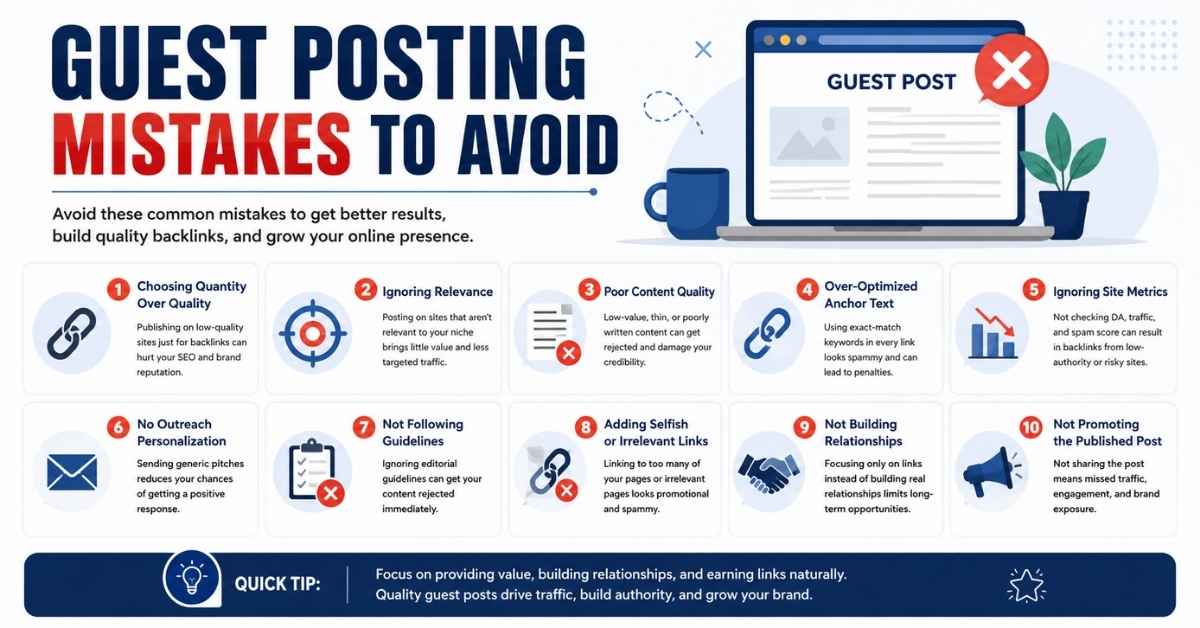
Guest Posting Mistakes to Avoid can waste your time, reduce your chances of getting published, and even hurt your website's SEO performance if ignored. Whether you're a blogger, business owner, or SEO professional, understanding these mistakes is essential for building high-quality backlinks, improving search rankings, and earning referral traffic from reputable websites. The most common guest posting mistakes include choosing irrelevant websites, sending generic outreach emails, over-optimizing anchor text, publishing low-value content, and ignoring editorial guidelines. In this guide, you'll learn how to avoid these errors with practical examples, expert insights, and proven strategies that help you build topical authority, strengthen your backlink profile, and create long-term publishing relationships.
Guest posting is no longer just about getting a backlink. Search engines now reward helpful, relevant, and trustworthy content that provides genuine value to readers. A single well-placed guest post on a respected, niche-relevant website can deliver more long-term SEO value than dozens of links from low-quality blogs. That's why avoiding common mistakes is just as important as writing a great article.
Why Avoiding Guest Posting Mistakes Matters More Than Ever
The landscape of guest blogging has changed significantly. Years ago, many marketers focused on publishing as many guest posts as possible. Today, success depends on quality over quantity.
Every guest post represents your brand. A poorly researched article or a backlink from an irrelevant website can damage your credibility instead of improving it.
Avoiding these mistakes helps you:
- Build a stronger backlink profile
- Improve organic traffic
- Increase search visibility
- Earn trust from publishers
- Drive qualified referral traffic
- Strengthen your topical authority
- Develop long-term relationships with website owners
Instead of chasing quick SEO wins, focus on creating content that readers genuinely find useful.
What Makes a Successful Guest Post Today?
Successful guest posting is built on three essential principles.
The Three Pillars of Effective Guest Posting
1. Relevance
Publishing on websites closely related to your niche creates stronger contextual signals and attracts readers who are genuinely interested in your content.
For example, a digital marketing article published on an SEO blog is far more valuable than the same article appearing on an unrelated lifestyle website.
2. Value
Editors publish content that educates, solves problems, or shares unique insights.
Before writing, ask yourself:
Would this article still be useful even without the backlink?
If the answer is yes, you're moving in the right direction.
3. Trust
Publishers want contributors who consistently deliver:
- Original research
- Accurate information
- Clear writing
- Practical advice
- Reliable sources
- Helpful examples
Trust is earned through quality, not shortcuts.
What Search Engines Reward in Guest Posts
Modern search engines evaluate guest posts using multiple quality signals, including:
- Editorial quality
- Topical relevance
- Helpful content
- Natural anchor text
- User engagement
- Contextual backlinks
- Content originality
- Positive user experience
The goal isn't simply to earn a backlink—it's to contribute meaningful content that deserves to rank and be shared.
The Biggest Guest Posting Mistakes to Avoid
Choosing Websites for the Wrong Reasons
Many guest posting campaigns fail before the article is even written because marketers select the wrong websites.
Focusing Only on Domain Authority
One of the biggest misconceptions is believing that Domain Authority (DA) alone determines a website's value.
While authority metrics can provide useful insights, they don't tell the complete story.
Instead, evaluate:
| Better Evaluation Metric | Why It Matters |
| Topical relevance | Stronger contextual backlinks |
| Organic traffic | Indicates real audience engagement |
| Editorial quality | Shows publishing standards |
| Indexing status | Confirms search engine visibility |
| Audience engagement | Demonstrates genuine readership |
| Outbound link quality | Helps identify spam risks |
A niche-relevant website with consistent organic traffic often provides more SEO value than a high-authority website unrelated to your industry.
Ignoring Topical Relevance
Publishing on unrelated websites weakens the impact of your backlinks.
Imagine writing about SEO strategies for a website focused entirely on pet care. Even if the site has impressive authority, the contextual relevance is low.
Always prioritize websites where your expertise naturally fits the audience.
Ask yourself:
- Does this audience need my content?
- Does the website regularly publish similar topics?
- Will readers genuinely benefit from this article?
If the answer is no, keep searching.
Publishing on Websites with Poor Organic Traffic
Some websites accept almost every guest post but attract very few visitors.
A backlink from a website with little or no organic traffic rarely generates meaningful SEO or referral benefits.
Before pitching, review factors such as:
- Consistent traffic trends
- Recently updated content
- Indexed pages
- Audience engagement
- Social sharing activity
Publishing where no one is reading offers limited long-term value.
Overlooking Editorial Standards
Low-quality websites often display warning signs, including:
- Thin articles
- Excessive advertisements
- Poor grammar
- Irrelevant outbound links
- Hundreds of guest posts across unrelated industries
- Little editorial review
Reputable websites maintain clear publishing guidelines and reject weak submissions.
Choosing quality publishers protects both your reputation and your backlink profile.
Outreach Mistakes That Get Your Pitch Ignored
Even excellent content won't be published if your outreach email fails to make a strong first impression.
Sending Generic Outreach Emails
Editors receive dozens of guest post requests every week.
An email that begins with:
"Dear Sir/Madam, I want to write a guest post."
will likely be ignored.
Instead:
- Address the editor by name.
- Mention a recent article you enjoyed.
- Explain why your topic benefits their audience.
- Keep your email concise and professional.
Personalization dramatically improves response rates.
Pitching the Wrong Person
Many marketers send emails to generic contact addresses without checking whether they're reaching the content editor.
Take a few minutes to identify:
- Content manager
- Editor
- Website owner
- Editorial team
Reaching the right person increases your chances of receiving a reply.
Ignoring Guest Posting Guidelines
Many websites publish contributor guidelines covering:
- Article length
- Formatting
- Image requirements
- Linking policy
- Writing style
- Submission process
Ignoring these instructions signals that you haven't taken the time to understand the publication.
Always follow every requirement carefully before submitting your pitch.
Asking for a Link Instead of Offering Value
Editors aren't looking for backlinks—they're looking for great content.
Instead of saying:
"Can I get a backlink?"
Focus on:
- Solving a reader's problem
- Sharing unique insights
- Providing useful research
- Offering practical examples
When your article adds value, backlinks become a natural outcome.
Following Up Too Aggressively
Following up is perfectly acceptable.
Sending five emails in one week isn't.
A professional follow-up schedule might look like this:
- Initial email
- Follow-up after 5–7 days
- Final reminder after another week
If there's still no response, move on respectfully.
Professionalism leaves a lasting impression.
Expert Insight: Editors are more likely to respond to contributors who demonstrate genuine interest in their audience rather than those who appear focused solely on acquiring backlinks.
Content Mistakes That Reduce Acceptance Rates
Your article is your strongest selling point. Weak content almost always leads to rejection.
Writing Thin or Generic Articles
Many guest posts simply repeat information already available online.
Instead of writing another generic article, include:
- Original insights
- Practical frameworks
- Industry examples
- Actionable tips
- Recent trends
Readers remember content that teaches them something new.
Covering Topics Already Published
Before pitching, review the website's existing articles.
Avoid submitting topics they've already covered extensively.
Instead, identify:
- Missing subtopics
- Updated information
- New case studies
- Fresh perspectives
- Advanced strategies
Editors appreciate contributors who expand their content library rather than duplicate it.
Creating Promotional Content Instead of Educational Content
Readers quickly lose interest when every paragraph promotes a product or service.
A successful guest post should educate first.
Promotion should remain subtle and limited to:
- Author bio
- Relevant resource recommendations
- Helpful references
Teach generously before asking for anything in return.
Using AI Without Human Editing
AI can speed up research and drafting, but publishing raw AI-generated text often results in:
- Repetitive wording
- Generic advice
- Weak transitions
- Inaccurate information
- Robotic tone
Always improve drafts by adding:
- Personal observations
- Real examples
- Updated statistics
- Expert commentary
- Natural storytelling
Human editing transforms average content into something readers genuinely enjoy.
Weak Research and Unsupported Claims
Statements like:
"Guest posting always boosts rankings."
lack credibility without evidence.
Support important points using:
- Industry studies
- Reliable statistics
- Official documentation
- Practical examples
- First-hand experience where applicable
Credible content builds confidence with both readers and publishers.
Poor Formatting and Readability
Even valuable content becomes difficult to read when presented as large blocks of text.
Improve readability by using:
- Short paragraphs
- Descriptive headings
- Bullet lists
- Tables
- Highlighted key points
- Clear transitions
Good formatting encourages readers to stay engaged from beginning to end.
SEO Mistakes That Can Hurt Rankings
Many guest posts fail to deliver SEO value because of avoidable optimization errors.
Over-Optimizing Anchor Text
Using the exact same keyword-rich anchor text repeatedly can make your backlink profile appear unnatural.
For example, repeatedly linking with the exact phrase "best SEO agency" across multiple guest posts may raise quality concerns.
A healthier approach is to diversify your anchor text with:
- Branded anchors (your business or website name)
- Natural phrases that fit the sentence
- Partial-match keywords where appropriate
- Generic anchors such as "learn more" or "this guide"
Natural anchor text creates a more balanced and trustworthy backlink profile.
Linking to Irrelevant Pages
Not every guest post should point to your homepage. Likewise, every backlink should serve a purpose.
Instead of linking randomly, ask:
- Does this page expand on the topic?
- Will readers genuinely benefit from visiting it?
- Does the destination match the context of the article?
For example, if you're writing about guest posting outreach, linking to a detailed outreach template is far more helpful than linking to a generic services page.
Contextual relevance improves user experience and makes your links more valuable.
Stuffing Keywords into Every Paragraph
While it's important to include your target keywords, forcing "guest posting mistakes to avoid" into every paragraph makes the content feel unnatural.
Search engines understand related language and context. Use variations such as:
- Guest blogging mistakes
- Guest posting best practices
- Common outreach errors
- Link-building mistakes
- Guest post SEO tips
Write naturally for readers first, and let semantic relevance support your optimization.
Ignoring Internal Linking Opportunities
Many contributors focus only on earning an external backlink and forget that internal links improve the user experience for the publisher as well.
Before submitting your article:
- Link to relevant articles already published on the website.
- Use descriptive anchor text.
- Avoid excessive internal links.
- Help readers discover related content naturally.
Editors appreciate contributors who strengthen their site's content ecosystem.
Building Too Many Guest Post Links Too Quickly
Publishing dozens of guest posts within a short period can create an unnatural backlink pattern.
Instead, focus on a consistent and sustainable strategy.
A healthy guest posting campaign prioritizes:
- Quality over quantity
- Diverse referring domains
- Natural publishing frequency
- Different anchor text variations
- Multiple content formats
Building authority takes time. Consistency delivers better long-term results than shortcuts.
Publishing Duplicate or Near-Duplicate Content
Reusing the same article across multiple websites is a common mistake.
Every guest post should provide:
- A fresh angle
- Unique examples
- Updated statistics
- Original insights
- Content tailored to the publisher's audience
Originality not only improves acceptance rates but also strengthens your reputation as a credible contributor.
Relationship-Building Mistakes
Guest posting isn't just about backlinks—it's about building relationships with editors and publishers.
Treating Guest Posting as a One-Time Transaction
Many marketers disappear after their article is published.
Instead:
- Thank the editor.
- Stay connected.
- Share future topic ideas.
- Offer additional value.
Strong relationships often lead to repeat publishing opportunities.
Never Promoting the Published Article
Your job doesn't end after publication.
Promote your guest post through:
- Social media
- Email newsletters
- Industry communities
- Relevant forums
More visibility benefits both you and the publisher, making future collaborations more likely.
Ignoring Reader Engagement
Readers may leave comments or ask questions about your article.
Responding thoughtfully helps:
- Build credibility
- Increase trust
- Encourage discussion
- Strengthen your personal brand
Active engagement shows that you're invested in helping readers, not just acquiring backlinks.
Failing to Build Long-Term Publisher Relationships
Editors prefer working with contributors they know and trust.
To build lasting relationships:
- Submit high-quality content consistently.
- Meet deadlines.
- Communicate professionally.
- Respect editorial feedback.
- Suggest fresh topic ideas regularly.
Long-term partnerships often generate better opportunities than constantly searching for new websites.
Performance Tracking Mistakes
Many people publish guest posts but never evaluate whether their efforts delivered results.
Never Measuring Referral Traffic
A successful guest post should generate more than just a backlink.
Track:
- Referral visitors
- Time on page
- Bounce rate
- Pages per session
These metrics help determine whether readers are engaging with your content.
Ignoring Conversion Data
Traffic alone doesn't guarantee success.
Measure meaningful outcomes such as:
- Newsletter sign-ups
- Contact form submissions
- Product inquiries
- Lead generation
- Sales
Ultimately, the goal is to grow your business—not just increase visitor numbers.
Focusing Only on Rankings
Higher rankings are valuable, but they aren't the only measure of success.
Also monitor:
- Brand visibility
- New referring domains
- Audience growth
- Publisher relationships
- Social shares
- Mentions across the web
A successful guest posting strategy supports your overall marketing goals.
Failing to Review Campaign Performance
Review every campaign to identify what worked and what didn't.
Ask yourself:
- Which websites sent the most qualified traffic?
- Which outreach emails received the highest response rate?
- Which topics attracted the most engagement?
- Which backlinks produced measurable SEO improvements?
Continuous improvement leads to stronger campaigns over time.
How to Evaluate a Guest Posting Website Before You Pitch
Choosing the right website is just as important as writing a great article.
| Evaluation Factor | Why It Matters | What to Check |
| Topical Relevance | Builds contextual authority | Is the website in your niche? |
| Organic Traffic | Indicates an active audience | Consistent search traffic |
| Editorial Quality | Reflects publishing standards | Well-written, updated articles |
| Outbound Link Profile | Helps identify spam | Natural and relevant external links |
| Audience Engagement | Shows real readership | Comments, shares, discussions |
| Indexing Status | Confirms visibility | Recently indexed pages |
Expert Tip: A highly relevant website with engaged readers often delivers more long-term SEO value than a high-authority website with little topical relevance.
A Simple Guest Posting Quality Checklist Before You Hit Send
Before submitting your article, review this checklist:
- ✅ Is the content original?
- ✅ Does it solve a real problem?
- ✅ Have you followed the publisher's guidelines?
- ✅ Is every claim accurate and supported?
- ✅ Are your anchor texts natural?
- ✅ Is the formatting easy to read?
- ✅ Have you included practical examples?
- ✅ Have you proofread for grammar and spelling?
- ✅ Does the article genuinely help readers?
- ✅ Would you proudly publish this on your own website?
If you answer "yes" to every question, you're ready to submit.
How to Recover If You've Already Made These Guest Posting Mistakes
Making mistakes doesn't mean your strategy has failed. The key is learning from them.
Audit Your Existing Guest Posts
Review all published guest posts and identify:
- Low-quality websites
- Broken links
- Thin content
- Poor anchor text
- Outdated information
Updating your strategy starts with understanding your current backlink profile.
Replace Low-Quality Backlinks
If you discover links from spammy or irrelevant websites, shift your focus toward earning backlinks from trusted, niche-relevant publications.
One quality backlink often provides more value than dozens of weak ones.
Improve Future Outreach
Analyze your outreach process.
Questions to ask:
- Was the email personalized?
- Did the topic fit the website?
- Did you explain the value clearly?
- Was your pitch concise?
Small improvements can significantly increase acceptance rates.
Refresh Weak Content
Turn average guest posts into exceptional resources by adding:
- Recent statistics
- Updated examples
- Better visuals
- Actionable frameworks
- Expert insights
High-quality content continues delivering value long after publication.
Build Stronger Publisher Relationships
Stay in touch with editors, thank them for opportunities, and continue sharing valuable ideas.
Strong relationships create repeat publishing opportunities and reduce the effort required for future outreach.
LEARN MORE: What Is White Hat Link Building?
Expert Tips for Consistently Successful Guest Posting
- Research every website before pitching.
- Prioritize topical relevance over vanity metrics.
- Write for readers first, search engines second.
- Personalize every outreach email.
- Diversify anchor text naturally.
- Share original insights, not recycled advice.
- Promote every published article.
- Track referral traffic and conversions.
- Review your results regularly and refine your strategy.
- Focus on long-term relationships instead of one-time backlinks.
Common Myths About Guest Posting
"More Guest Posts Always Mean Better Rankings"
Publishing more guest posts doesn't automatically improve SEO. Quality, relevance, and authority matter far more than quantity.
"High Domain Authority Guarantees Success"
A website with impressive authority isn't necessarily the best choice if it lacks topical relevance or an engaged audience.
"Paid Guest Posts Are Always Safe"
Paying for placement doesn't guarantee quality. Always evaluate the website's editorial standards, audience, and overall reputation.
"One Guest Post Will Transform Your SEO"
Guest posting is a long-term strategy. Consistent, high-quality contributions produce stronger and more sustainable results than expecting instant ranking improvements.
Frequently Asked Questions
Does guest posting still work for SEO in 2026?
Yes. Guest posting remains effective when you publish original, valuable content on relevant, trustworthy websites. The focus should be on helping readers rather than simply acquiring backlinks.
Can guest posting hurt my website?
Yes. Publishing on spammy websites, using manipulative anchor text, or prioritizing quantity over quality can weaken your backlink profile and damage your SEO performance.
How many guest posts should I publish each month?
There's no universal number. A few high-quality guest posts on authoritative, niche-relevant websites usually outperform dozens of low-quality placements.
What makes a guest post high quality?
A quality guest post is:
- Original
- Well researched
- Relevant to the audience
- Easy to read
- Backed by credible information
- Focused on solving real problems
Should I pay for guest posting opportunities?
If you consider paid placements, evaluate the website carefully. Prioritize editorial quality, audience relevance, and long-term value over price alone.
How long does it take to see results from guest posting?
Referral traffic can appear soon after publication, while measurable SEO improvements often take several weeks or months depending on your niche, competition, and overall link-building strategy.
What is the best anchor text for guest post backlinks?
A healthy backlink profile uses a mix of:
- Branded anchors
- Natural phrases
- Partial-match keywords
- Generic anchors
Avoid repeatedly using the same exact-match keyword.
How do I identify spammy guest posting websites?
Watch for warning signs such as:
- Very low organic traffic
- Thin or duplicate content
- Excessive outbound links
- Poor editorial quality
- Irrelevant topics
- Little audience engagement
Final Thoughts
Avoiding Guest Posting Mistakes to Avoid is essential if you want your guest blogging efforts to produce lasting SEO results. The most successful campaigns aren't built on shortcuts—they're built on quality content, topical relevance, ethical link building, and strong publisher relationships.
Instead of chasing every guest posting opportunity, invest your time in researching reputable websites, creating genuinely helpful content, and personalizing your outreach. Monitor your performance, refine your strategy, and continue learning from every campaign.
When you focus on delivering value first, high-quality backlinks, stronger organic traffic, improved search rankings, and lasting authority become natural outcomes of a well-executed guest posting strategy.
Expert in SEO and link building with over 10 years of experience helping businesses grow their organic presence.