How to Evaluate a Backlink: 12 Proven SEO Quality Checks for 2026
Write a compelling excerpt...
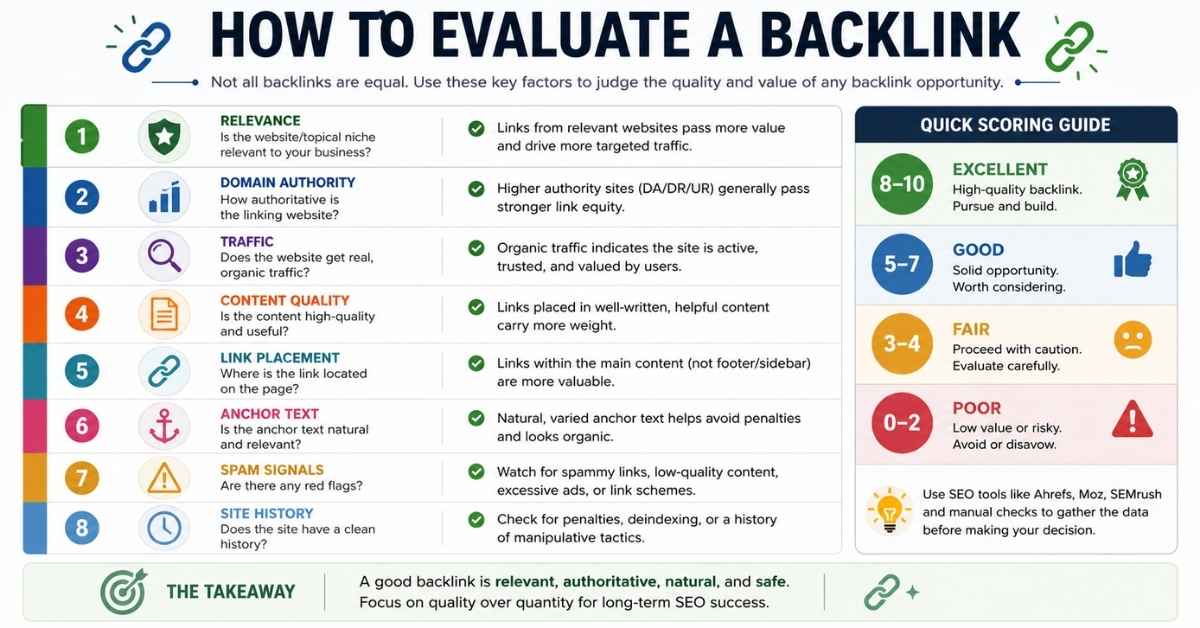
How to Evaluate a Backlink is one of the most valuable SEO skills because not every backlink helps your website rank. A high-quality backlink comes from a relevant, trustworthy website, appears naturally within valuable content, receives real traffic, and strengthens your site's authority and topical relevance. Instead of relying only on metrics like Domain Authority (DA) or Domain Rating (DR), you should evaluate a backlink using multiple factors, including editorial quality, contextual placement, organic traffic, anchor text, and trust signals.
With Google's algorithms becoming more sophisticated, successful link building is no longer about collecting as many backlinks as possible. Search engines now reward websites that earn contextual backlinks, maintain a natural backlink profile, and demonstrate strong E-E-A-T (Experience, Expertise, Authoritativeness, and Trustworthiness). Whether you're considering a guest post, editorial mention, or digital PR opportunity, knowing how to evaluate a backlink before investing your time or money can protect your SEO strategy and improve long-term organic rankings.
How to Evaluate a Backlink: The Quick Answer
The quickest way to evaluate a backlink is to ask one simple question:
Would this link still be valuable if search engines didn't exist?
If the answer is yes, you're probably looking at a quality backlink.
A good backlink should:
- Come from a topically relevant website.
- Receive genuine organic traffic.
- Be placed naturally within helpful content.
- Appear on a trusted website with strong editorial standards.
- Offer value to real readers instead of existing only for SEO.
While metrics such as Domain Authority, Domain Rating, and Page Authority can provide useful context, they should never be the only factors influencing your decision.
Why Backlink Evaluation Matters More Than Ever
Years ago, SEO campaigns often focused on the number of backlinks a website could acquire. Today, that strategy can do more harm than good.
Google's ranking systems increasingly reward websites that earn high-quality backlinks from relevant, trustworthy sources while ignoring—or even devaluing—manipulative link-building practices.
Evaluating every backlink before pursuing it helps you:
- Build topical authority
- Improve search visibility
- Protect your website from spammy links
- Increase referral traffic
- Strengthen your brand reputation
- Maximize your return on investment
The Biggest Myth About Backlink Quality
One of the most common misconceptions is that a backlink from a website with a very high Domain Rating is automatically valuable.
Imagine you run a gardening blog and receive an opportunity to get a backlink from a high-authority casino website. Despite the impressive authority metrics, the backlink offers little topical relevance and is unlikely to provide meaningful value for your audience.
Now compare that with a backlink from a respected gardening publication that has lower authority but thousands of engaged readers. In most cases, the second backlink is the better investment because it aligns with your niche, audience, and content.
This example shows why experienced SEOs always prioritize relevance before metrics.
The 12-Step Backlink Evaluation Framework
Instead of guessing whether a backlink is worth pursuing, use this practical framework. Following these twelve steps will help you identify valuable opportunities while avoiding low-quality links that add little SEO value.
1. Check Topical Relevance First
The first question should always be:
Is this website closely related to my niche?
Google values semantic relationships between websites. A backlink from a highly relevant industry publication usually carries more weight than one from an unrelated site with stronger authority metrics.
Consider:
- Industry relevance
- Content category
- Audience overlap
- Business similarity
- Subject expertise
For example:
A fitness equipment store receiving a backlink from a health magazine makes perfect sense.
The same website receiving a backlink from an unrelated cryptocurrency blog creates a weaker contextual relationship.
Topical relevance should always be your highest priority.
2. Review the Website's Trustworthiness
Not every website with strong metrics deserves your trust.
Look beyond SEO tools and examine the website itself.
Ask yourself:
- Does the site publish original content?
- Are articles professionally written?
- Is the author clearly identified?
- Is there an About page?
- Does the website maintain consistent editorial standards?
- Does it have a positive online reputation?
Trustworthy publishers usually demonstrate clear editorial processes and prioritize readers over search engines.
Strong trust signals often indicate a safer backlink opportunity.
3. Analyze Organic Traffic
Traffic tells a story that authority metrics cannot.
A website with genuine organic traffic demonstrates that Google already trusts its content.
Look for signs such as:
- Consistent monthly traffic
- Ranking keywords
- Stable growth
- Active audience
- Updated content
Be cautious of websites showing:
- Sudden traffic spikes
- Significant ranking declines
- No visible search traffic
- Artificial engagement patterns
A backlink from a website with real visitors can generate both SEO value and referral traffic.
4. Evaluate the Linking Page
Many people focus only on the overall domain while ignoring the individual page that will contain the backlink.
A quality linking page should be:
- Well written
- Helpful
- Recently updated
- Properly indexed
- Relevant to your topic
- Free from excessive advertisements
Even a respected website can publish weak pages.
Always evaluate the exact page where your backlink will appear.
5. Examine Link Placement
Where a backlink appears often matters as much as the backlink itself.
The strongest backlinks are usually:
- Embedded naturally within the main content
- Surrounded by relevant context
- Positioned where readers naturally engage
Less valuable placements include:
- Sidebars
- Footers
- Author bio sections
- Large link directories
A contextual backlink inside an informative paragraph generally carries more value than a footer link appearing across hundreds of pages.
6. Assess Anchor Text
Anchor text helps search engines understand the relationship between the linked pages.
Healthy backlink profiles include a natural mix of:
- Branded anchors
- Generic anchors
- Partial keyword anchors
- Natural descriptive phrases
Avoid backlinks that repeatedly use identical keyword-rich anchor text because excessive optimization may appear manipulative.
Natural anchor text improves both user experience and search engine understanding.
7. Review Authority Metrics
Authority metrics remain useful—but only when interpreted correctly.
Common metrics include:
- Domain Authority (DA)
- Domain Rating (DR)
- URL Rating (UR)
- Page Authority (PA)
Treat these numbers as supporting indicators rather than final decisions.
For example:
A DR 80 website with no topical relevance may provide less SEO value than a DR 35 website operating within your industry.
Authority without relevance rarely produces the strongest results.
8. Inspect Outbound Links
Quality websites are selective about the websites they reference.
Review the page and ask:
- Does it link to trustworthy sources?
- Are outbound links relevant?
- Is the page overloaded with promotional links?
- Does every paragraph contain affiliate links?
Pages filled with dozens of unrelated outbound links often indicate poor editorial quality.
Healthy websites maintain a balanced outbound link profile focused on helping readers.
9. Identify Spam Signals
Learning to recognize spam saves both time and money.
Watch for warning signs such as:
- Thin or duplicate content
- Poor grammar
- AI-generated articles with little value
- Private Blog Networks (PBNs)
- Expired domains repurposed for link building
- Excessive advertising
- Hundreds of unrelated categories
- Hidden ownership information
If several red flags appear together, the backlink opportunity is usually best avoided.
10. Consider Referral Traffic Potential
A backlink shouldn't only improve rankings.
It should also send qualified visitors to your website.
Ask yourself:
- Will readers actually click this link?
- Does the website attract my target audience?
- Is the content engaging?
- Will visitors benefit from learning more about my business?
High-quality referral traffic often leads to better engagement, more conversions, and stronger brand awareness.
11. Estimate Link Longevity
Some backlinks disappear within months.
Others continue delivering value for years.
Evergreen content, industry guides, research reports, and educational resources often provide long-lasting backlink value because publishers continue updating and promoting them.
Long-term backlinks generally produce better ROI than temporary placements.
12. Assign a Quality Score
Once you've completed your evaluation, score the backlink using a simple framework.
| Evaluation Factor | Suggested Weight |
| Topical Relevance | 25% |
| Organic Traffic | 20% |
| Editorial Quality | 15% |
| Trust Signals | 10% |
| Authority Metrics | 10% |
| Contextual Placement | 10% |
| Anchor Text | 5% |
| Outbound Link Profile | 5% |
A backlink scoring above 85% is typically a strong opportunity worth pursuing.
Rather than chasing every available backlink, focus on opportunities that combine relevance, editorial quality, contextual placement, trust, and real audience value. This approach builds a healthier backlink profile, strengthens topical authority, and supports sustainable organic growth over the long term.
Backlink Evaluation Checklist
Before you invest time, money, or effort into acquiring a backlink, run through this simple checklist. It helps you identify valuable opportunities while filtering out low-quality links.
Quick Backlink Quality Checklist
- ✅ Is the website topically relevant to your niche?
- ✅ Does it receive genuine organic traffic?
- ✅ Is the linking page indexed in Google?
- ✅ Is the content original, helpful, and well-written?
- ✅ Does the website follow strong editorial standards?
- ✅ Is the backlink placed naturally within the content?
- ✅ Is the anchor text relevant and not over-optimized?
- ✅ Does the page avoid excessive outbound links?
- ✅ Is the website trusted by users and search engines?
- ✅ Can the backlink drive referral traffic in addition to SEO value?
If you answer "Yes" to most of these questions, the backlink is likely worth pursuing.
Real Examples of Good and Bad Backlinks
Understanding backlink quality becomes much easier when you compare real scenarios.
Example 1: High Authority but Poor Relevance
Imagine you own a website that sells hiking gear.
You receive a backlink offer from a DR 90 entertainment website with almost no outdoor-related content.
Although the authority metric looks impressive, the backlink lacks topical relevance, making it less valuable for your SEO strategy.
Verdict: Not the best choice.
Example 2: Lower Authority but Highly Relevant
Now imagine another opportunity.
A respected outdoor adventure blog with DR 35, consistent organic traffic, and thousands of engaged readers offers to mention your hiking guide within a detailed article.
Even though the authority is lower, the backlink appears naturally in highly relevant content.
Verdict: Excellent backlink opportunity.
Example 3: Editorial Link vs. Paid Guest Post
Suppose you publish original research on sustainable travel.
A well-known travel magazine references your report and links to it naturally. This editorial backlink demonstrates trust, relevance, and editorial discretion.
At the same time, you publish a thoughtful guest post on another travel website with a contextual backlink to your guide.
Both backlinks provide value, but the editorial link generally carries stronger trust signals, while the guest post improves topical authority and expands your audience.
Lesson: A diverse backlink profile often delivers the best long-term SEO results.
How to Evaluate Backlinks for Different Website Types
Not every website should follow the same backlink strategy. Your evaluation criteria may vary depending on your business model.
Local Businesses
Local businesses should prioritize backlinks from:
- Local news websites
- Community organizations
- Regional blogs
- Industry associations
Priority Evaluation Factors: Local relevance, trust, and referral traffic.
Ecommerce Stores
Online stores benefit from backlinks appearing in:
- Buying guides
- Product reviews
- Industry blogs
- Shopping resources
Priority Evaluation Factors: Commercial relevance, editorial quality, and user intent.
SaaS Companies
Software businesses often compete in highly competitive search results.
The strongest backlinks usually come from:
- Technology publications
- Industry research
- Digital PR campaigns
- Expert blogs
Priority Evaluation Factors: Authority, topical relevance, and editorial mentions.
Affiliate Websites
Affiliate marketers should evaluate backlinks carefully because aggressive link-building often attracts spam.
Focus on:
- Relevant niche blogs
- High-quality resource pages
- Educational content
- Trusted publishers
Priority Evaluation Factors: Context, quality, and audience alignment.
Enterprise Brands
Large organizations benefit from backlinks that strengthen brand recognition.
Editorial mentions, research citations, and industry publications often provide the greatest value.
Priority Evaluation Factors: Brand trust, authority, and long-term visibility.
Common Mistakes When Evaluating Backlinks
Many website owners repeat the same mistakes, reducing the effectiveness of their link-building strategy.
Avoid these common errors:
- Relying only on Domain Authority or Domain Rating
- Ignoring topical relevance
- Choosing websites with little or no organic traffic
- Overlooking editorial quality
- Using repetitive keyword-rich anchor text
- Purchasing backlinks without reviewing the publisher
- Ignoring referral traffic potential
- Chasing quantity instead of quality
Remember, one exceptional backlink often outperforms dozens of weak links.
Red Flags That Signal a Low-Quality Backlink
The following comparison makes it easier to identify strong and weak backlink opportunities.
| Good Signs | Warning Signs |
| Relevant content | Irrelevant niche |
| Genuine organic traffic | No visible traffic |
| Professional editorial standards | Thin or AI-generated content |
| Natural anchor text | Keyword stuffing |
| Trusted publisher | Private Blog Network (PBN) |
| Helpful articles | Duplicate or low-value content |
| Balanced outbound links | Excessive promotional links |
| Indexed pages | Deindexed or poorly maintained pages |
If multiple warning signs appear together, it's usually better to avoid the backlink altogether.
LEARN MORE: Editorial Links vs Guest Posts
Should You Pursue, Monitor, or Avoid This Backlink?
Once you've completed your evaluation, classify the opportunity using this simple framework.
Pursue
A backlink is worth pursuing if it has:
- Strong topical relevance
- Genuine organic traffic
- High editorial standards
- Natural contextual placement
- Positive trust signals
- Long-term value
Monitor
Proceed carefully when:
- Traffic is declining.
- Authority metrics look inflated.
- Editorial quality is inconsistent.
- The website recently changed ownership.
Gather more information before making a final decision.
Avoid
Walk away from backlinks that show:
- Spam indicators
- Private Blog Networks
- Hidden ownership
- Thin content
- Excessive outbound links
- Irrelevant topics
- Manipulative anchor text
- Poor user experience
Protecting your backlink profile is just as important as building it.
Tools That Help Evaluate Backlinks
SEO tools can simplify backlink analysis, but they should support—not replace—your own judgment.
Useful categories include:
- Backlink analysis tools to review referring domains and link profiles.
- Organic traffic tools to estimate search visibility.
- Spam analysis tools to identify potential risks.
- Indexation tools to confirm whether pages are indexed.
- Technical SEO tools to review website health.
Use these tools to collect data, then apply the evaluation framework you've learned throughout this guide.
Frequently Asked Questions
What makes a backlink high quality?
A high-quality backlink comes from a relevant, trustworthy website, appears naturally within valuable content, and provides both SEO value and potential referral traffic.
Is Domain Authority the most important metric?
No. While Domain Authority can be useful, topical relevance, editorial quality, trust signals, and organic traffic are often more important.
Can a low-authority backlink still improve SEO?
Yes. A backlink from a smaller but highly relevant website with an engaged audience can outperform one from a larger but unrelated site.
Should I prioritize traffic or authority?
Ideally, look for both. However, if you must choose, a relevant website with consistent organic traffic often provides more practical value than a high-authority site with little audience engagement.
How can I identify a toxic backlink?
Watch for signs such as spammy content, excessive outbound links, hidden ownership, poor editorial quality, and irrelevant topics. These characteristics may indicate a harmful backlink.
Are nofollow backlinks worth evaluating?
Yes. Although they may not pass the same ranking signals as follow links, nofollow backlinks can still increase brand awareness, drive referral traffic, and contribute to a natural backlink profile.
Final Thoughts
Learning how to evaluate a backlink is one of the smartest investments you can make in your SEO strategy. Rather than chasing the highest Domain Authority or collecting as many links as possible, focus on what truly matters: topical relevance, editorial quality, trust, contextual placement, organic traffic, and user value.
Before pursuing any backlink opportunity, apply the 12-step evaluation framework and score each link objectively. This process helps you avoid low-quality websites, spend your outreach budget more effectively, and build a stronger backlink profile over time.
The most successful websites don't rely on shortcuts. They earn and acquire backlinks that make sense for their audience, strengthen topical authority, and align with Google's emphasis on helpful, trustworthy content. By consistently evaluating every backlink before accepting it, you'll build a healthier link profile that supports sustainable organic rankings, long-term search visibility, and lasting business growth.
Expert in SEO and link building with over 10 years of experience helping businesses grow their organic presence.